



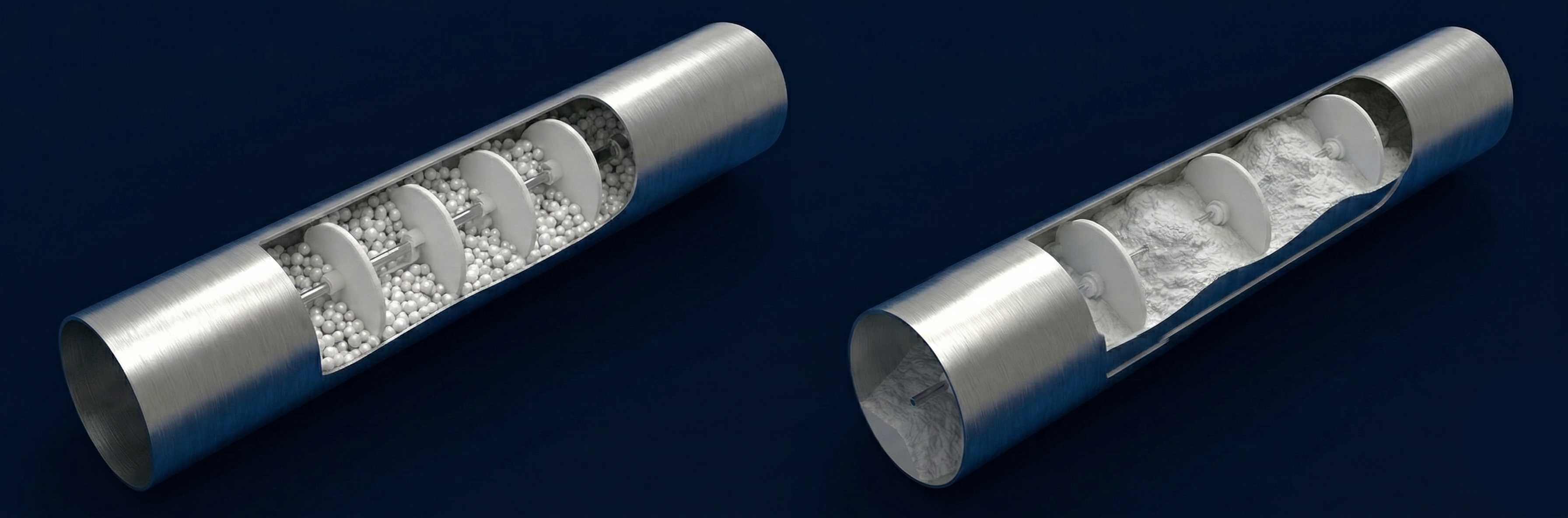
The mechanical conveyor is a reliable solution to automate and optimize the transport of powders and bulk materials within industrial production processes.
Industrial production automation is today one of the most effective ways to reduce operating costs, increase production volumes, and improve the working environment.
Powders and bulk solids are at the core of many industrial production processes. For this reason, having an efficient and safe bulk material handling system can become a real competitive advantage that makes a difference in the market.
The operating principle is simple yet highly effective: a rope or chain equipped with plastic discs moves inside a closed tube, creating a conveying circuit where multiple loading and unloading points can be installed according to the needs of the plant.
Companies choose this conveying system mainly for five reasons.
- ENERGY EFFICIENCY
A bulk material handling system directly impacts the overall energy consumption of a production plant.
Mechanical chain conveyors are designed to transport both large and small quantities of material with very low energy consumption.
For example, it is possible to reach a conveying capacity of 60 m³/h with only 7.5 kW of power on a 50-meter circuit, ensuring an efficient and energy-sustainable transport solution.
- LOW MAINTENANCE REQUIREMENTS
It might be assumed that components such as rope or chain require frequent maintenance. In reality, after a short initial settling period, their durability is very high.
Under normal operating conditions the lifespan can reach:
- 1–2 years for rope systems
- 3–5 years for chain systems
Additionally, these conveying systems do not require filtration units for operation, further reducing maintenance activities and operating costs.
- LONG CONVEYING DISTANCES
Mechanical bulk material conveying systems can cover considerable distances while maintaining low motor power and consistent capacity.
Aeromechanical conveyors can easily reach heights of up to 25 meters, while mechanical chain conveyors can extend up to 300 meters in total circuit length.
This capability allows the design of highly efficient conveying circuits even in complex industrial plants.
- FLEXIBILITY AND ADAPTABILITY OF THE CONVEYING SYSTEM
One of the main advantages of mechanical conveyors is their high level of configuration flexibility..
Thanks to the modular design of the system, the conveyor can be adapted to the specific needs of each facility and easily integrated into existing production lines.
The conveying circuit can be assembled with bends, pipes, loading points, and discharge points, allowing the system to meet the operational requirements of different industrial applications.
This modular configuration makes it possible to optimize plant layout and improve the overall efficiency of the production process.
- ZERO DUST DISPERSION
Workplace safety is a key factor in industrial environments, especially when handling powders or potentially hazardous materials.
The mechanical conveyor circuit is completely enclosed, preventing dust from dispersing into the surrounding environment.
This applies both during loading operations (big bags or bag cutting stations) and during material discharge.
Additionally, hermetically sealed solutions are available to completely avoid contact between the transported material and the operator, further improving plant safety.
CONCLUSIONS
Automating the handling of powders and bulk materials is now a strategic choice to improve productivity, safety, and energy efficiency in industrial plants, and selecting the right conveying system is equally important.
Mechanical chain conveyors represent a reliable and proven solution that has been used for more than 65 years across multiple industries.
If you would like to test your product or receive more information on how to automate material transport in your plant, contact us or visit the HiWay website.