


In the handling of bulk materials within industrial plants, pneumatic conveying is often the first choice dictated by “habit”. However, settling for the status quo could mean missing out on important opportunities for energy and operational optimization.
When power consumption, product integrity, filtration, quietness, and the need for multipoint distribution become decisive factors, evaluating an alternative is not only useful, but necessary.
HOW MECHANICAL AND AERO-MECHANICAL CONVEYORS WORK
Mechanical disc conveyors boast a history spanning over sixty years: their invention dates back to 1960, the year the first patent was filed. Our company’s history is rooted in this innovation.
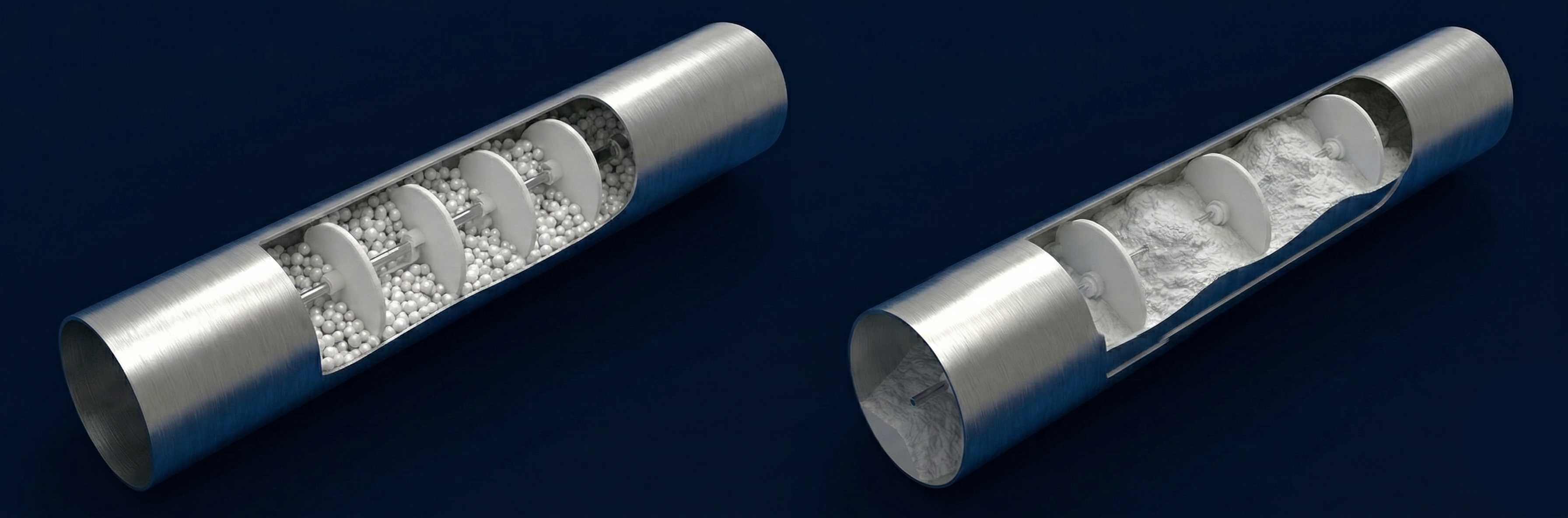
In mechanical conveyors, a chain or wire rope with discs molded at regular intervals runs inside a closed piping circuit. The chain, driven by a motor, drags the product from the loading point to one or more discharge points.Nei convogliatori meccanici, una catena o fune con dei dischi stampati ad intervalli regolari scorre all’interno di un circuito di tubazioni chiuse. La catena, azionata da un motore, trascina il prodotto dal punto di carico fino a uno o più punti di scarico.
Exactly as in pneumatic systems (both dense and dilute phase), the product travels in a totally closed environment, eliminating dust dispersion in the workplace. Furthermore, the flexibility of the layout and the length of the path are highly customizable thanks to the use of special idler corners (return pulleys).
ARE MECHANICAL CONVEYORS ALWAYS SUPERIOR TO PNEUMATIC CONVEYING?
We define these technologies as “alternatives” precisely because both can prove to be extremely effective depending on the application context.
- Short distances and low throughputs: If the distance between the loading point and the discharge point is very short and the throughput is minimal, the optimal choice might fall on a small pneumatic system, a screw conveyor, or a flexible spiral conveyor.
- Frequent washing (CIP): In the case of continuous and recurring Clean-in-Place washes, pneumatic conveying has fewer natural dead spots. If the goal is to handle many different materials on the same line with zero contamination tolerance, air offers an intrinsic advantage.
- The wear factor: There is often a fear of wear on moving mechanical parts. Although friction exists, it falls within normal routine maintenance management. Under standard operating conditions (with non-abrasive materials and periodic checks), a chain can easily reach a useful life of 3 to 5 years.
WHEN DOES THE WIRE ROPE OR CHAIN CONVEYOR BECOME THE IDEAL CHOICE?
To answer this question, we need to look back at the first paragraph.
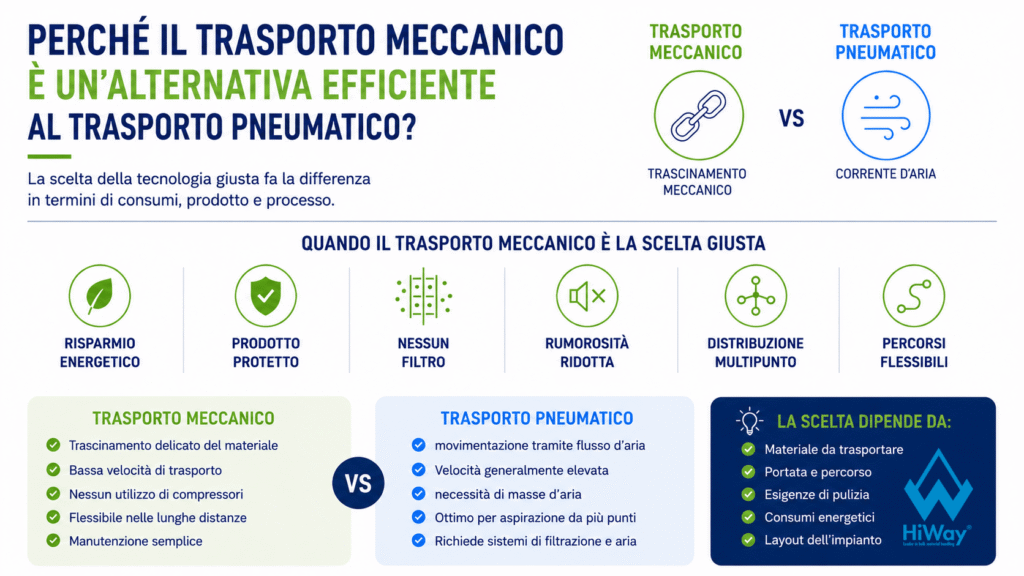
- Energy savings: This is the most obvious and impactful factor, both economically and ecologically. Tubular mechanical conveyors can move up to 60 m³/h with a power of just 15 kW. If we look at aero-mechanical conveyors—which exploit dynamic fluidization without requiring external air generators—it is possible to reach 35 m³/h with a consumption of only 3 kW.
- Product and mixture integrity: When preserving the homogeneity of the material is fundamental, the low speed of the chain (about 0.5 m/s) ensures extremely gentle conveying that does not crush or unmix pre-dosed compounds, as the product remains protected in the “pockets” between one disc and the next.
- Acoustic comfort: Since there are no compressors or vacuum pumps, the only potential source of noise is the sliding of the discs in the tube. However, the technopolymer that the discs are made of and the very presence of the transported powder act as insulators, drastically reducing the acoustic impact in the facility.
- Automation and multiple discharges: In addition to the ability to lift material vertically up to 15-20 meters with a single machine (using aero-mechanical systems), mechanical conveyors allow the integration of multiple loading points and infinite partializable discharge points, managed automatically via PLC for total process automation.
CONCLUSIONS
Stating that there is an absolute best conveying method for industrial powders would be a mistake. Every technology has its strengths, and it is fundamental to analyze the specific needs of the product, space, and energy budget.
At HiWay, we have been operating in this sector for over 65 years, designing, manufacturing, and installing custom-made plants. Do you want to find out what the perfect solution is for your facility? Contact us today or visit the official HiWay website.